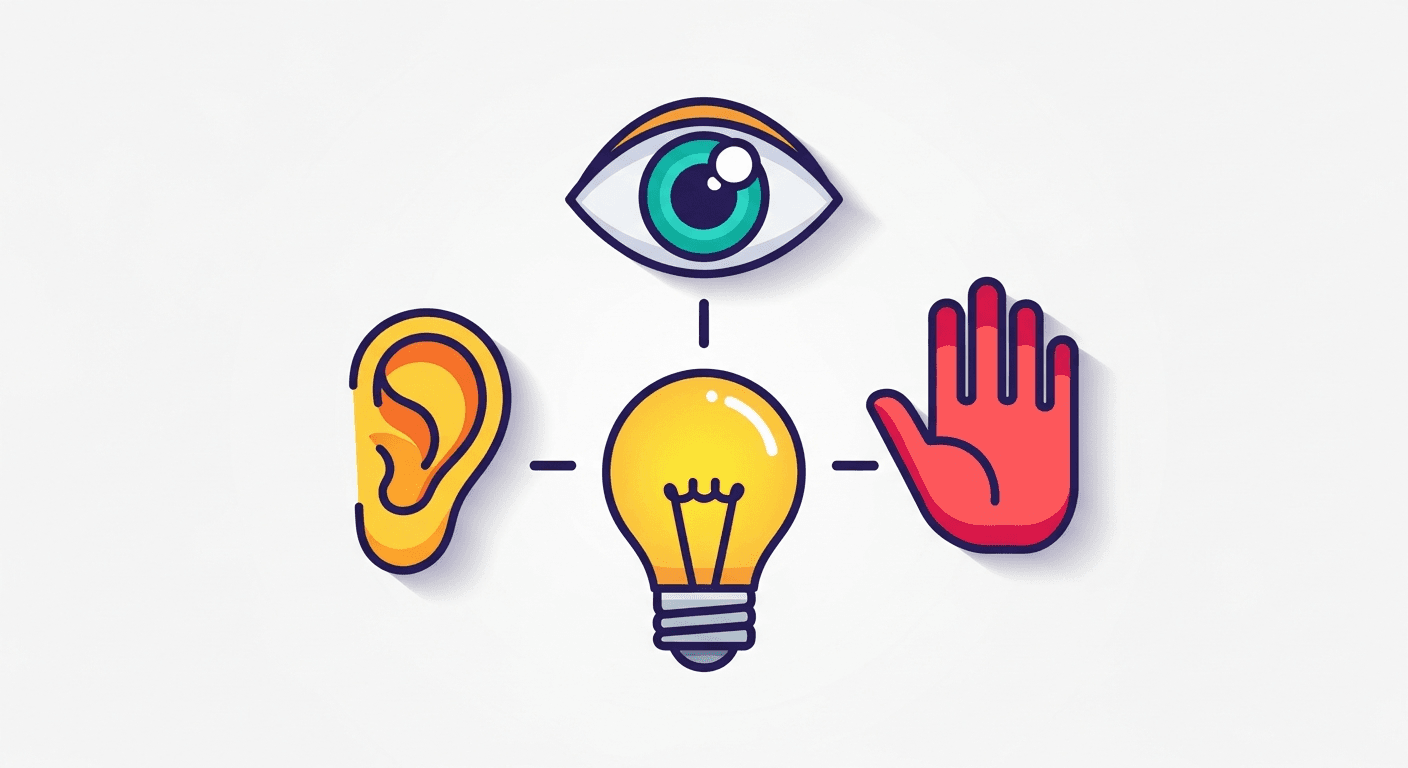
The idea that kids are visual, auditory, or kinesthetic learners is everywhere in education — and it's not supported by science. Here's what is.
If you have school-age children, you have probably encountered the idea of "learning styles" — the theory that different children learn best through different modalities: visual, auditory, or kinesthetic.
You may have been told your child is a "visual learner" and should use diagrams and color-coded notes. You may have adjusted your homework support approach around this belief.
There's just one problem: the learning styles theory, despite being ubiquitous in education, is not supported by scientific evidence.
What the Research Shows
The learning styles hypothesis makes a specific claim: that students perform better when taught in a way that matches their preferred style. This is a testable claim, and it has been tested — extensively.
A major review of the evidence published in Psychological Science in the Public Interest examined the research and found that while students do have preferences for how they receive information, those preferences don't predict which format will be most effective for their learning.
In other words: a self-described "visual learner" doesn't necessarily learn better from diagrams than from text. They prefer diagrams, but preference and effectiveness are different things.
This is called the "meshing hypothesis," and it consistently fails to hold up in controlled studies.
Why Does It Persist?
The learning styles myth persists for several understandable reasons:
It feels true.* Most people do have a preference for how they receive information. But preferences and learning effectiveness are different things.
It's appealing.* It gives children an identity ("I'm a visual learner"), reduces judgment ("I'm not bad at this — I just learn differently"), and gives parents and teachers a framework for thinking about individual differences.
It's been institutionalized.* It's in teacher training programs, parenting books, and educational assessments. Overturning widespread belief takes time even when evidence accumulates.
What Actually Predicts How Well Children Learn
Prior knowledge.* The single strongest predictor of how well someone will learn new material is how much they already know about the subject. New information attaches to existing knowledge — and if there's nothing to attach it to, it slides off.
The nature of the content.* Some content genuinely is better conveyed visually: geometry, spatial relationships, certain scientific processes. Other content is better conveyed verbally: arguments, narratives, abstract concepts. The match should be between content and modality — not between the child's preference and modality.
Active engagement.* Regardless of modality, students learn more when they're actively processing information than when they're passively receiving it. Explaining, applying, questioning, and producing are all more effective than watching or listening.
Motivation and interest.* A child who is interested in the subject will learn it more easily and retain it longer — regardless of how it's presented.
Spaced practice and retrieval.* How the material is reviewed over time matters more than how it was originally taught.
What This Means for Homework Support
Don't change your homework support strategy based on a learning styles label. If your child has been told they're a "kinesthetic learner" and "doesn't do well with reading," the answer isn't to avoid text-based work — it's to build reading skills and use varied, active approaches to all content.
What is worth doing:
- •Match the modality to the content (use diagrams for spatial concepts, discussion for argumentative essays)
- •Use multiple modalities for complex content (read it, draw it, explain it)
- •Focus on whether the child is actively processing, not passively receiving
- •Build prior knowledge before introducing new material in a subject
The Takeaway
Your child is not a visual learner or an auditory learner in any scientifically meaningful sense. They are a learner — and the evidence points toward strategies that work for almost all learners: active engagement, spaced practice, retrieval, and building knowledge.
That's more useful than a label, and more actionable than adjusting to a style that may not be doing the work you think it is.