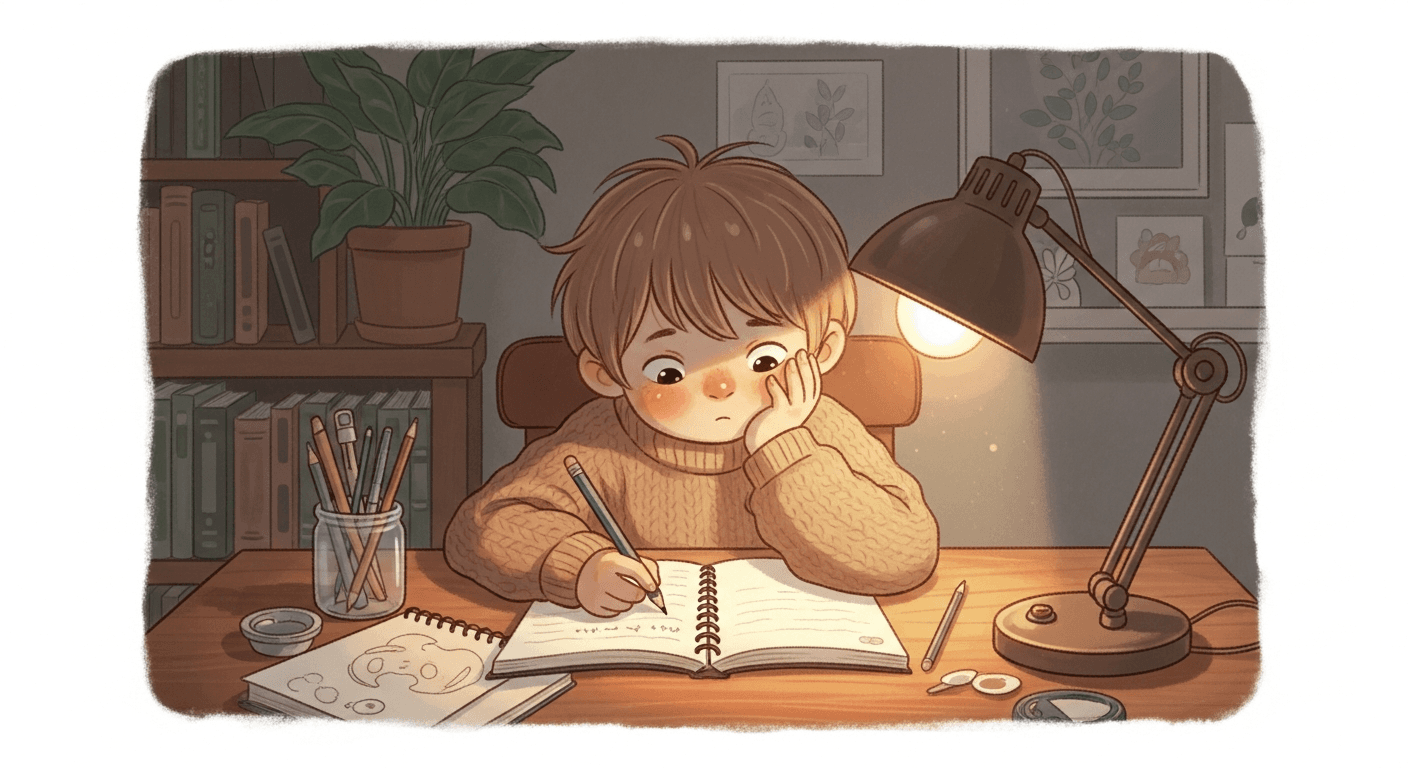
Helping with essays and written work is the area where parents most often accidentally cross the line. Here's how to stay on the right side of it.
Writing homework is the category where parent involvement most often tips from helpful to counterproductive — and it happens gradually, without anyone intending it.
It starts with fixing a sentence. Then suggesting a better word. Then restructuring a paragraph. Then, one night, you're basically writing the thing while your child watches. The essay gets a good grade, your child learns very little, and you've accidentally trained them to be a helpless writing client.
Here's how to help without taking over.
Why Writing Is Different
Most homework help is subject-specific: math problems have right answers, science questions have correct information. Writing is different because it requires expressing your child's thinking — and when you start expressing it for them, the work is no longer theirs in any meaningful sense.
This matters beyond the immediate assignment. Writing is thinking made visible. Students who develop genuine writing skills become clearer thinkers. Students who become skilled at getting their parents to write for them learn nothing about either.
The Stages of a Writing Assignment (and How to Help at Each)
Before writing: the planning stage
This is where parent involvement is most valuable and most appropriate. Ask questions:
- •"What's the essay supposed to be about?"
- •"What's your main point?"
- •"What are your three best reasons or examples?"
- •"How do you want to end it?"
You can also help them create a simple outline. The outline belongs to them — you're asking questions that help them build it, not building it yourself.
During drafting: mostly stay out
The first draft should be entirely theirs, even if it's rough. A bad first draft that belongs to them is worth more than a polished draft that belongs to you.
If they get stuck on a specific sentence or idea, the most useful thing you can say is: "Just say it to me out loud, then write down what you said." Most children write more stiffly than they talk. Getting them to verbalize helps.
During revision: focus on questions, not corrections
Instead of: "This sentence doesn't make sense" (leaves them helpless)
Try: "I'm not sure I understand what you mean here — can you explain it to me?" (they fix it)
Instead of: "You should say 'however' instead of 'but'" (you made the choice)
Try: "Is there a more formal word that could work here?" (they make the choice)
The distinction is: they make every change. You only ask questions that help them see what needs changing.
Common Mistakes
Editing grammar before content.
Before worrying about grammar, make sure the ideas are there. A grammatically perfect paragraph that says nothing interesting is worse than a messy paragraph with a real idea in it. Revise content first, mechanics later.
Writing "better" versions of their sentences.
Even showing them a revised version of their sentence — intending them to learn from it — often results in them just copying your version without understanding why it's better. Questions produce more learning than demonstrations.
Over-involvement in the topic selection.
If the prompt gives any flexibility, the child should choose their own topic, even if their instinct seems less interesting than what you would pick. Writing about something you chose is fundamentally different from writing about something someone else chose for you.
When Their Draft Is Really Bad
You sit down to read the first draft and it's genuinely poor — unclear, short, off-topic. This is normal. First drafts are supposed to be messy.
Resist the urge to tell them everything that's wrong. Pick the two or three most important issues and ask questions about those. "I'm noticing your second paragraph and your third paragraph seem to make the same point — is that intentional?" is more useful than delivering a full critique.
The Standard to Hold to
A parent's job in writing homework is to be the reader — not the editor, not the co-author. Your role is to say "I got a little lost here" or "This part was really clear." Then let your child figure out what to do about it.
If you can maintain that role consistently, you're teaching them to write to an audience — which is, ultimately, what writing is.